
 RUSAGARA MUVUNANKIKO Valens

As Rwanda continues to seek ways to increase agricultural productivity while protecting its soil, a farming approach known as Conservation Agriculture is being introduced to farmers in different parts of the country.
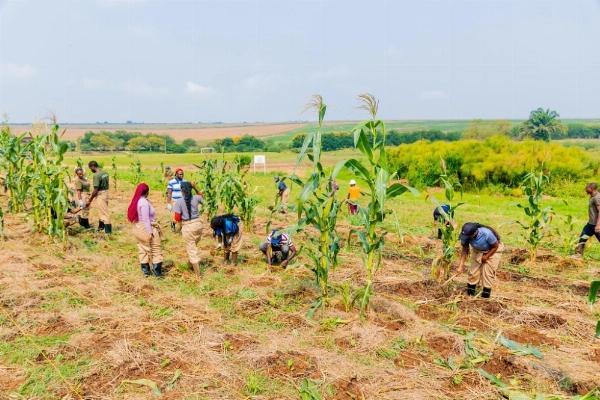
Under this approach, farmers minimize soil disturbance compared to conventional farming practices. Instead, crop residues and vegetation are left on the farm to cover the soil, while cultivation is carried out in a way that causes less disturbance to the soil structure.
Leandre Rwakayanga, Station Manager at RAB/Tamira Station, says one of the key principles of Conservation Agriculture is reducing soil disturbance.
“Conservation Agriculture is farming that is done without disturbing the soil. You simply cut or clear the vegetation on the surface using a small hoe, and then leave the vegetation you have cleared on the field.” He said
When rain falls, instead of hitting the bare soil directly, it falls onto these residues, which reduce the speed of the water. The water moves more slowly, reducing the chances of valuable topsoil being washed away.
Rwakayanga says the approach can also reduce the amount of labor farmers normally use when preparing their fields.
“Conservation Agriculture reduces the amount of digging a farmer has to do. For one person to cultivate two ares in a day is not easy. But if you are only clearing the vegetation and leaving the residues behind, one person can clear four or even five ares.”
One of the key features of this type of farming is that the soil is not left bare.
Crop residues and vegetation left on the field gradually decompose, adding organic matter to the soil.
Rwakayanga says this can also help farmers generate organic manure directly in their fields rather than having to obtain it from elsewhere.
“The residues remain in the field and gradually decompose over time. This makes it easier for the farmer because organic matter is already beginning to form.”
RAB says the approach is based on three main principles: minimizing soil disturbance, keeping the soil covered, and practicing crop rotation.
Under conventional farming, farmers may cultivate the soil several times and remove weeds and crop residues completely so that the field appears clean and fully prepared before planting.
However, this new approach requires farmers to accept that a field does not have to look completely clean and bare to be well managed.
One farmer from Rubavu, Jean Bosco Niyonzima, says he previously did not believe that leaving vegetation on the farm could be beneficial.
“We used to think that a good farm was one that had been thoroughly cultivated, with no weeds and with all the soil turned over. When you saw residues left on a field, you thought the farmer had not done a good job. Now we are beginning to see that these residues can actually benefit the soil.”
Another farmer, Vestine Mukamana, says she previously removed all crop residues before planting again.
“We always removed all the weeds and crop residues, believing that this was what helped crops grow well. Now we have been taught that some of these residues can be left on the soil to protect it and help it retain moisture.”
The problem of soil degradation is not new in Rwanda. According to the Agricultural Household Survey 2024 conducted by NISR, 23% of agricultural households reported experiencing soil erosion, while 25.7% reported declining soil fertility.
Meanwhile, in the Seasonal Agricultural Survey 2026 Season A, 92.4% of farmers reported carrying out at least one soil erosion control measure on their farms.
This shows that protecting soil is not an issue affecting individual farmers alone, but one of the major challenges that needs to be addressed as Rwanda seeks to increase agricultural productivity in a sustainable manner.
Rwanda’s terrain also makes soil erosion an important concern. REMA reports that nearly 90% of Rwanda’s land is located on slopes, making soil vulnerable to being washed away by water if it is not properly protected.
Conservation Agriculture is no longer simply an experimental practice. The Ministry of Agriculture and Animal Resources has incorporated the approach into PSTA 5 as part of efforts to build a sustainable and climate-resilient agricultural sector.
In 2024/2025, the area under Conservation Agriculture stood at 1,173 hectares, with a target of expanding the practice to 100,000 hectares by the 2028/2029 fiscal year. The government says RWF 2.4 billion has been planned to support this target.
The approach is also supported by Rwanda’s environmental legal framework. Law Nº48/2018 of 13 August 2018 relating to the environment, under Article 27, provides for measures to prevent soil erosion and degradation and to restore degraded land.