
 Daniel Ngendahimana
Rwanda imported about 6,100 tons of sunflower-seed and safflower oil in 2024, worth roughly US$8.41 million. This is according to World Bank World Integrated Trade Solution (WITS) data based on UN Comtrade records. Meanwhile, donor-backed programmes are working to raise local sunflower output.
The 2024 total combines two customs categories: 1,440.93 tons of crude oil worth US$1.59 million, and 4,658.68 tons of other sunflower oil worth US$6.82 million. The categories cover safflower oil as well as sunflower oil. The data therefore do not reveal how much sunflower oil Rwanda consumes or produces.
Ukraine was the largest supplier of crude oil, at 1,152,680 kg worth about US$1.202 million. Uganda followed with 192,000 kg (about US$275,740), then Austria with 96,170 kg (about US$115,860).
FAO data published by Our World in Data put 2024 sunflower seed output at about 17.2 million tons in Russia and 11 million in Ukraine. Argentina produced about 3.9 million and China about 2.35 million. Africa produced about 2.51 million tons, led by Tanzania (about 1.2 million), South Africa (about 632,000) and Uganda (about 285,000).
The outlook for the current season is stronger. Global sunflower production in 2026-27 is forecast to rise 12% to 62.06 million metric tons after two years of below-average yields driven by dry weather. Oil World projects a record 62–63 million tons under normal weather. Ukraine’s crop is expected to recover only moderately and to stay well below pre-conflict levels. Rwanda gets much of its imported oil from Ukraine, so that matters locally.
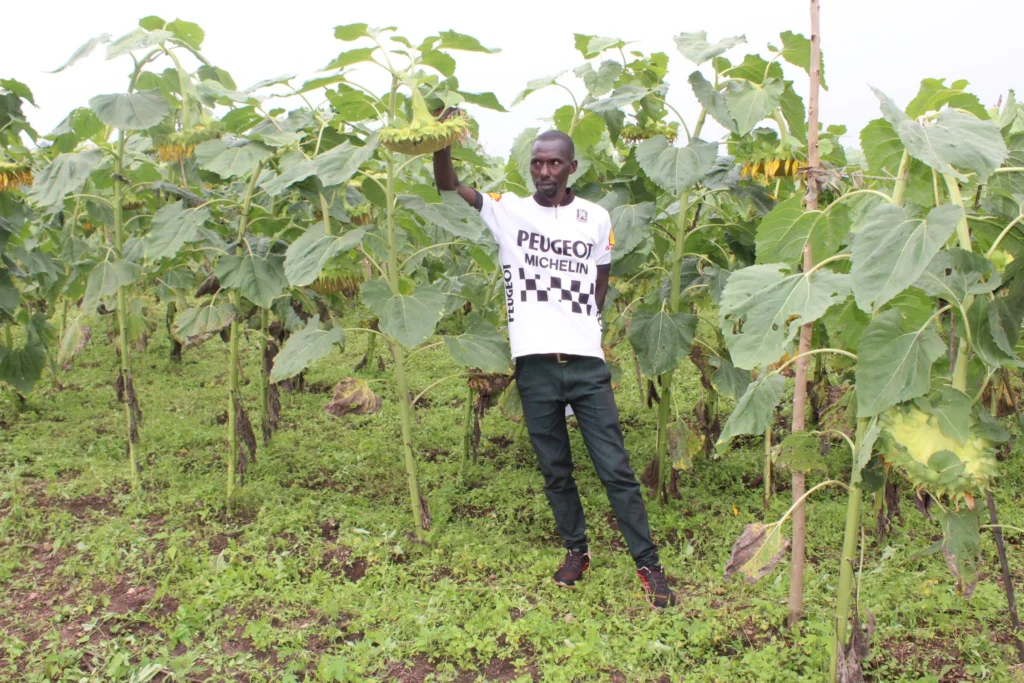
Sunflower farming in Rwanda is still small, but it is organised and growing. The Ibihwagari (“sunflower”) Project, run by EUCORD with Achmea Foundation funding, ran from 2022 to 2025. It trained 6,298 farmers, 51% of them women, from 32 cooperatives in sunflower production, good agricultural practices and post-harvest handling. Farmers produced 340.5 tons of sunflower on 208 hectares, and two oil plants processed 10,215 litres of virgin oil from it. That works out to a yield of about 1.6 tonnes per hectare.
A second phase is now under way. The €278,000 project runs from 2026 to 2028 and from 1 July 2026, expands into Ngoma, Gisagara and Nyanza districts. Its targets include training 8,000 farmers, producing 2,250 tons of sunflower oil and 3,375 tons of animal feed and generating more than €1.5 million in net income. The project responds both to the low incomes of subsistence smallholders and to the import of raw materials for local edible oil refineries.
For scale, the Phase II oil target is equal to roughly 37% of Rwanda’s 2024 sunflower and safflower oil imports. The comparison is only indicative, because the target is a project-wide goal for 2026–2028 and the import figure is for a single year.
Sunflower oil is only a small part of Rwanda’s edible oil market. Earlier government figures put annual imports at an average of about 125,000 metric tons, against local production of at least 80,000, which made Rwanda a net importer.
Imports peaked at 126,002 tons in 2020. In 2020 the country spent Rwf106 billion on cooking oil imports and the import duty was cut from 35% to 25% because local production was still low. These figures are several years old and the source does not break them down by oil type.
The US National Institutes of Health Office of Dietary Supplements lists sunflower seeds as a source of vitamin E. About 28 g of dry-roasted seeds provide 7.4 mg, around 49% of the US daily value.
They also supply protein, minerals and unsaturated fats. They are energy-dense, however, and salted varieties can be high in sodium. They are a nutritious food, not a treatment for any disease.
Rwanda’s imports show a clear gap between demand and local supply. Local programmes are still small next to that demand. The next few seasons will show whether Phase II can raise output and give processors a reliable local source of seed.

 RUSAGARA MUVUNANKIKO Valens