
 RUSAGARA MUVUNANKIKO Valens
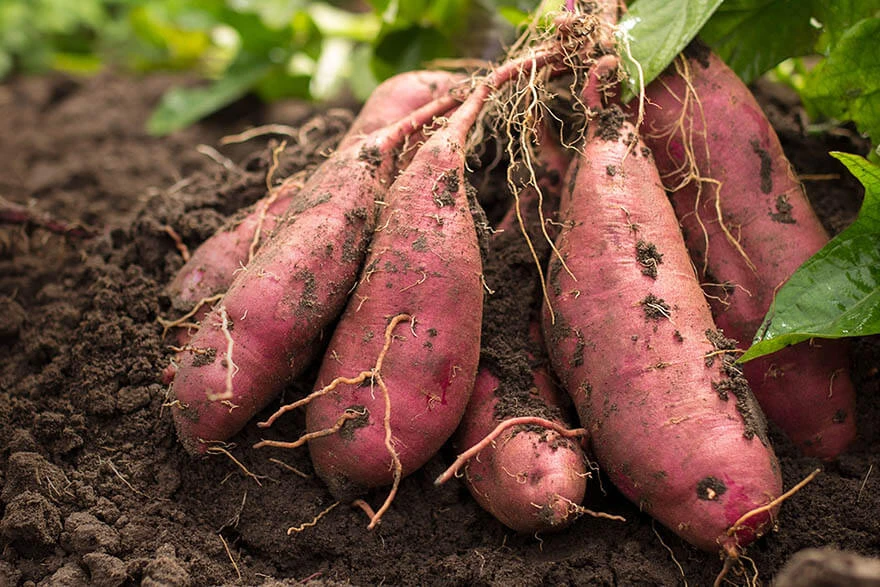
A report published by the National Institute of Statistics of Rwanda (NISR) in December 2025 shows that Rwanda harvested 1,350,124 tons of sweet potatoes across the three agricultural seasons of 2025. As farmers continue to grow the crop, market price data for October 2026 shows that a kilogram of sweet potatoes sells for between RWF 300 and RWF 1,200 in some markets.
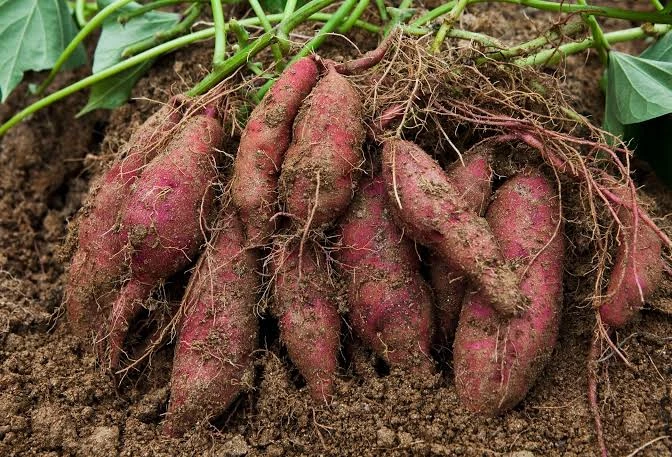
Sweet potatoes are among the crops that contribute to food security for many households in Rwanda. Besides providing energy, they can also supply essential nutrients, depending on the variety. However, for the crop to make a greater contribution to farmers’ livelihoods, it is important to examine production levels, market prices and opportunities for processing and export.
The National Institute of Statistics of Rwanda’s report, Seasonal Agricultural Survey 2025, published in December 2025, shows that Rwanda’s sweet potato production reached 1,350,124 tons across agricultural Seasons A, B and C of the 2024/2025 agricultural year.
NISR data shows that during Season A of 2025, which ran from September 2024 to February 2025, Rwanda harvested 656,320 tons of sweet potatoes. This represented a decline of approximately 5.3% compared with the same season in 2024.
During Season B of 2025, which ran from March to June, production reached 652,515 tons, representing a decline of approximately 2.1% compared with the previous year.
In Season C of 2025, which ran from July to September, production reached 41,289 tons, an increase of approximately 8% compared with the same season in 2024.
Combined, the three seasons recorded a total sweet potato harvest of 1,350,124 tons in Rwanda.
These figures show that sweet potatoes occupy an important place in the country’s agricultural sector, although production levels vary across the different seasons.
The NISR report published in December 2025 shows that the districts leading in sweet potato production vary depending on the agricultural season.
During Season A of 2025, Gicumbi, Gakenke, Nyamagabe and Nyaruguru were among the districts reported to have recorded the highest production.
In Season B, Nyamagabe, Gakenke, Nyaruguru and Ngororero were among the leading districts, while Nyaruguru, Burera, Rubavu and Gisagara featured among the important production areas during Season C.
These findings demonstrate that sweet potatoes are cultivated across different parts of the country. However, identifying the leading district for the entire year requires comparing district-level production figures across all three seasons rather than relying on data from a single season.
The NISR report for the 2024/2025 agricultural year shows that the average sweet potato yield during Season B of 2025 was 8.1 tons per hectare, up from 7.7 tons per hectare during the same season in 2024.
This represents an increase of approximately 5.2% in yield per hectare.
Although total production declined by 2.1% during the season, yield per hectare increased. This demonstrates why agricultural analysis should consider not only the total volume harvested but also the amount of produce obtained from each hectare of cultivated land.
While the 2025 agricultural report provides an overview of national production, market data for October 2026 offers a picture of the prices currently faced by consumers and traders.
Market price data published by the Ministry of Agriculture and Animal Resources, based on prices collected by Esoko Rwanda, shows that on 26 October 2026, a kilogram of sweet potatoes sold for RWF 700 at Mulindi and Batsinda markets in Kigali, the lowest prices recorded in the city. At Kimironko Market, the same quantity sold for RWF 1,200.
In the Eastern Province, the lowest price was recorded at Matimba Market in Nyagatare District, where a kilogram sold for RWF 500. The highest price among the markets mentioned in the province was RWF 800 at Kiramuruzi Market in Gatsibo District.
In the Northern Province, the lowest price was recorded at Byumba Market in Gicumbi District, where a kilogram sold for RWF 650. At Musanze Market in Musanze District, the price reached RWF 700.
In the Southern Province, sweet potatoes were cheapest at Butare Market in Huye District, where a kilogram sold for RWF 400. The price reached RWF 700 at Nyanza Market.
In the Western Province, the lowest price was recorded at Congo Nil Market in Rutsiro District, while the highest price among the markets mentioned in the province was RWF 700 at Kibuye Market in Karongi District.
According to these figures, the Southern Province recorded some of the lowest sweet potato prices, while Kigali experienced the highest prices among the markets listed.
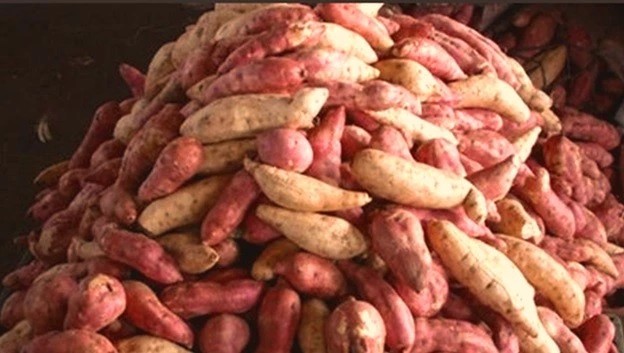
At the international level, figures from the Food and Agriculture Organization of the United Nations (FAO), as reported by Our World in Data, show that global sweet potato production reached 142.5 million tons in 2024.
The data, updated on 25 February 2026, shows that China ranked first globally, producing 51.4 million tons of sweet potatoes.
Malawi ranked second, with 7.98 million tons, followed by Nigeria, which produced 4.09 million tons. Tanzania and Angola were also among the major sweet potato-producing countries.
Rwanda produced approximately 1.4 million tons in 2024, placing it seventh globally in the ranking.
This places Rwanda among the countries making a notable contribution to global sweet potato production, although its output remains far below China’s.
Across Africa, total sweet potato production reached 28.5 million tons in 2024, accounting for approximately 20% of global production. Malawi was the continent’s leading producer.
A report from the World Integrated Trade Solution (WITS), based on 2023 data from UN Comtrade, shows that the United States exported 253,740 tons of dried sweet potatoes, valued at US$170.6 million.
The Netherlands exported 142,106 tons, worth US$158.6 million, while Egypt exported 101,042 tons valued at US$127.3 million.
For Rwanda, such opportunities would depend on factors including processing capacity, product quality, market demand and the ability to meet export requirements.
Sweet potatoes are a source of energy because they are rich in carbohydrates. Depending on the variety, they can also provide fiber, potassium, vitamin C and beta-carotene, which the body converts into vitamin A.
Orange-fleshed sweet potatoes contain more beta-carotene than white-fleshed varieties. Vitamin A supports normal vision, immune function and healthy growth.
A study conducted by Jan Low and colleagues, published in The Journal of Nutrition in 2007, examined a program promoting the cultivation and consumption of orange-fleshed sweet potatoes among children in rural Mozambique.
The researchers found that the program helped increase the amount of vitamin A consumed by children through their diets. Retinol levels in the blood also increased among participants in the intervention group.
Another study by Hotz and colleagues, published in The Journal of Nutrition in 2012, also demonstrated the contribution of program promoting orange-fleshed sweet potato production and consumption to increasing vitamin A intake among communities in Mozambique.
These findings indicate that orange-fleshed sweet potatoes can help address vitamin A deficiency when incorporated into regular diets. However, they do not mean that sweet potatoes alone can resolve all nutritional problems or serve as a treatment for disease.
NISR figures published in December 2025 show that Rwanda harvested more than 1.35 million tons of sweet potatoes across the three agricultural seasons of 2025. At the global level, FAO data updated in February 2026 indicates that Rwanda ranked among the world’s top 10 sweet potato producers in 2024.
Beyond their contribution to food security, sweet potatoes offer potential opportunities for improving farmers’ incomes through processing and access to export markets. Understanding production trends, yields and market prices will therefore be important in determining how the crop can contribute further to Rwanda’s agricultural development.


 Daniel Ngendahimana